

How to Identify and Address Complicated (Prolonged) Grief

Grief is a subject that can be easy to tiptoe around. It’s the natural response to the loss of someone who was meaningful. But what happens when grief lingers?
When a loved one dies, many people experience grief that eventually subsides as they acclimate back into their life and routine. However, prolonged grief disorder (PGD) is a diagnosable mental health condition—formally added to the DSM-5-TR in March 2022 and the ICD-11 in 2019—characterized by intense, persistent grief that significantly impairs daily functioning.
Prolonged grief disorder (PGD) can affect more than just emotions; it can take over someone’s life. According to the American Psychiatric Association (APA), PGD can be associated with suicidal ideation and significant functional impairment, and it frequently co-occurs with depression, anxiety, and post-traumatic stress disorder (PTSD). It’s important to recognize the struggle people with PGD experience – when starting over again feels like the last thing they want to do.
What Types of Grief Exist?
Grief doesn’t look the same for everyone. Depending on the time frame, researchers commonly distinguish three phases of grief, as described by Columbia University’s Center for Prolonged Grief.
ACUTE GRIEF

INTEGRATED GRIEF

PROLONGED (or COMPLICATED) GRIEF

Since the original publication of this article, prolonged grief disorder has been officially recognized in two major diagnostic systems: the DSM-5-TR (American Psychiatric Association, 2022) and the ICD-11 (World Health Organization, 2019). The DSM-5-TR requires that symptoms be present for at least 12 months in adults (6 months in children and adolescents), while the ICD-11 threshold is 6 months. Both systems require that the intensity and duration of grief clearly exceed cultural, social, or religious norms and cause significant functional impairment.
What Are The Causes of Prolonged Grief?
Prolonged grief disorder affects how someone adapts to a loss. According to Columbia University’s Center for Prolonged Grief, healthy adaptation involves three key processes:
- Accepting reality by recognizing the loss is final and there are consequences.
- Reconfiguring an internalized relationship with the deceased.
- Finding fulfillment and joy in living life and moving forward with purpose.
Dr. Natalia Skritskaya, a psychologist at the Center for Prolonged Grief, believes all people have a built-in biological capacity to adapt that helps restore normalcy, re-envision the future, and re-engage with life. But when something gets in the way of this process, the grief can become “frozen,” with emotional intensity remaining persistently high.
“We’ve been using the six-month benchmark for adaption to loss, but there’s some debate about certain losses being harder to adapt to – such as a loss of a parent or child, a violent loss, or sudden, unexpected loss of a younger person,” Skritskaya said.
According to the American Psychiatric Association, an estimated 4%–15% of bereaved adults will experience the persistent symptoms of prolonged grief disorder. A 2024 cross-national systematic review (Comtesse et al., Journal of Affective Disorders) estimated that approximately 13% of the bereaved adult population met ICD-11 criteria, though rates vary significantly by sampling methods and loss circumstances. Developing PGD depends heavily on the circumstances surrounding the death and individual risk factors.
RISK FACTORS FOR PROLONGED GRIEF DISORDER (per the American Psychiatric Association and peer-reviewed research) INCLUDE:
Events
- Natural versus traumatic violent death – suicide, homicide, accident, finding the loved one’s body after a violent death
- Death in a hospital versus home, or not being present when the loved one dies
- “Preventable death” (perceived negligence of treatment where it seems that the death could have been prevented)
- Multiple deaths around the same time
- Witnessing the death
Relationships
- High marital dependency (if spouse has died)
- Close relationship to a dying patient
Personal History
- History of trauma and losses
- Attachment issues
- Lower socioeconomic status or lack of social support
What Are Symptoms of Complicated Grief?
Grieving a loss can be strenuous and debilitating. Many prolonged grief symptoms appear like acute grief; the difference is that the symptoms persist for at least 12 months in adults (per DSM-5-TR) or 6 months (per ICD-11) and cause significant impairment in daily functioning (American Psychiatric Association, 2022).
PER THE DSM-5-TR, A DIAGNOSIS OF PROLONGED GRIEF DISORDER REQUIRES INTENSE YEARNING/LONGING OR PREOCCUPATION WITH THE DECEASED, PLUS AT LEAST THREE OF THE FOLLOWING SYMPTOMS, OCCURRING NEARLY EVERY DAY FOR AT LEAST ONE MONTH:
- Intense emotional pain (e.g., sadness, anger, bitterness, guilt)
- Difficulty accepting the death
- Avoidance of reminders of the loss
- Feeling that life is meaningless without the deceased
- Identity disruption (e.g., feeling that part of oneself has died)
- Feeling emotionally numb, detached, or unable to experience positive emotions
- Intense loneliness or feeling that no one else could understand the depth of loss
- Difficulty engaging in ongoing activities or pursuing future goals
The APA notes that people with PGD may also experience difficulty with normal routines, social withdrawal, and feelings of self-blame. Importantly, PGD is a distinct diagnosis from major depressive disorder and PTSD, though these conditions frequently co-occur.
“It’s very natural to start thinking of alternative scenarios or things you could have done to prevent the death,” said Skritskaya.
How Does the Body Respond to Complicated Grief?
Grief affects more than emotional responses – it’s also linked to physical responses. Physiological dysregulation manifests through various areas of the body due to grief, said Skritskaya. From sleep to appetite, it can impact daily functioning
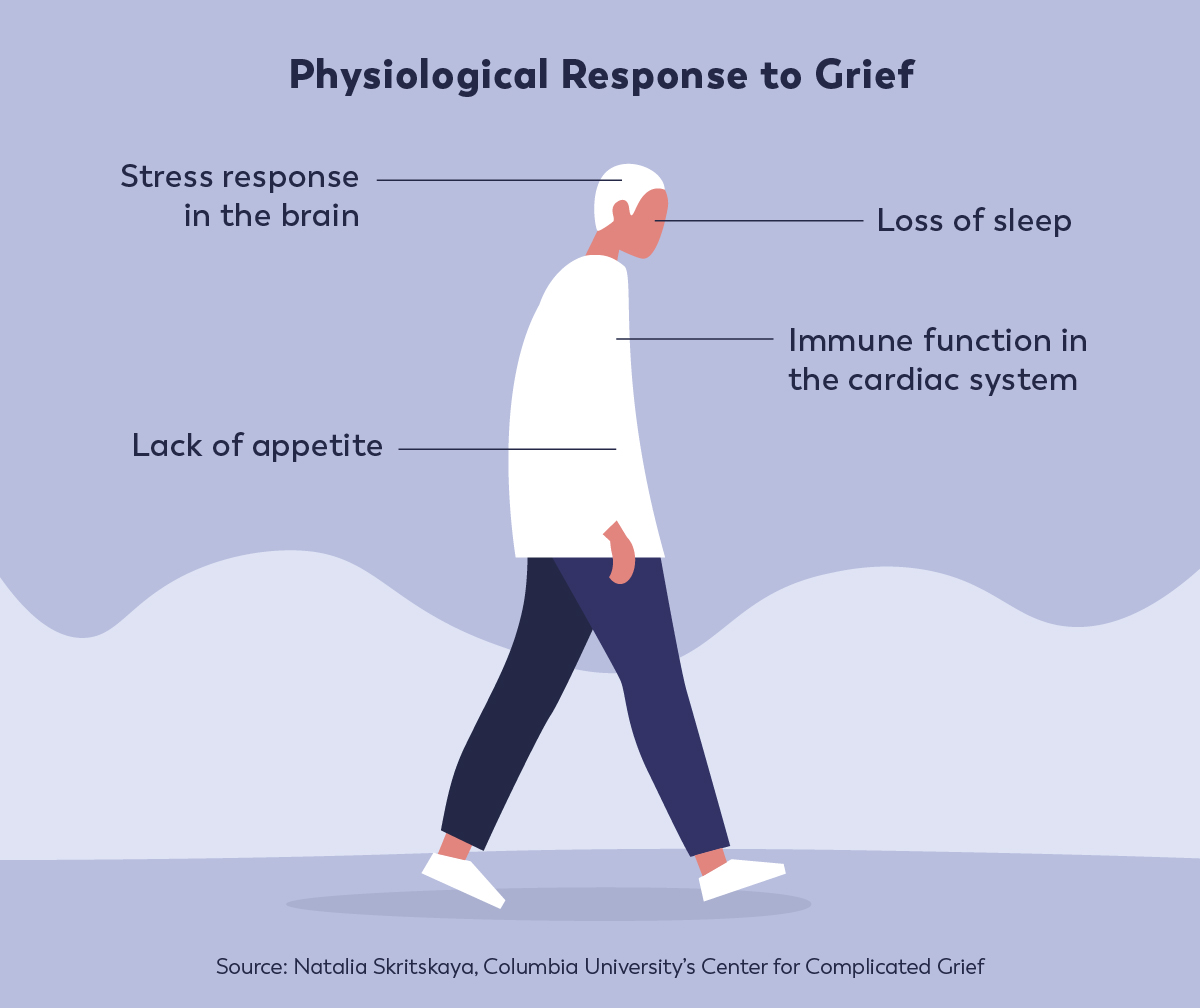
The body responds physically to grief through the brain’s stress response, disrupted sleep, reduced appetite, and weakened immune and cardiovascular function. Research published in Psychological Science (Brown et al., 2022) found that grief symptoms are associated with elevated inflammatory markers during stress in bereaved spouses, underscoring the biological toll of bereavement.
How to Address Complicated Grief
Many people who grieve feel pressure to recover from a loss.
“I think we have a cultural attitude that no one wants to hear about death or that they might feel awkward around a grieving person, so people don’t know what to say,” said Skritskaya. “But we don’t grieve well alone.”
One place to turn for support is to a counselor or mental health professional. The gold-standard, evidence-based treatment for PGD is Prolonged Grief Therapy (PGT)—formerly called Complicated Grief Treatment (CGT)—a 16-session manualized intervention that has demonstrated efficacy in multiple randomized controlled trials (Shear et al.; LaPlante et al., Behavior Therapy, 2024). PGT incorporates elements of cognitive-behavioral therapy (CBT) and attachment theory to help clients accept the reality of the loss and work toward restoration and future goals. Cognitive-behavioral therapy (CBT) more broadly, including online and group formats, has also demonstrated effectiveness. A 2025 systematic review and network meta-analysis (Pleshka et al.) found that the most effective PGD treatments combined elements of exposure, social support, narrative reconstruction, and cognitive-behavioral approaches.
Interviewing is one way a counselor can assist a client with the grieving process and take a closer look at prolonged grief. The Grief and Mourning Status Interview and Inventory (GAMSII) is a guided interview tool that addresses the circumstances of the death, the meaning of what’s been lost, coping mechanisms, the grieving person’s response to death, and the overall understanding of the grieving process. The interview technique offers suggestions for questions covering five topics.
STEP 1: ASK PERMISSION TO DISCUSS THE DEATH
- “Would this be a good time to talk about [the deceased]?”
- “How would it be for you if we talked about [the deceased]?”
- “Is there at least one person you can talk to about your grief? Who would be a good person to share your grief with?”
- “You can stop at any time you want. Just share what you’re comfortable with.”
STEP 2: ASK ABOUT THE CIRCUMSTANCES OF THE DEATH
- “What do you recall about how you responded at the time of the event?”
- “Put yourself back there now. How did you hear about the death?”
- “How have your feelings changed over time?”
- “What was the most emotionally difficult part of the experience for you?”
STEP 3: ASK ABOUT CURRENT GRIEF EXPERIENCES
- “How has your life changed since [the deceased] died?”
- “How much does your grief still interfere with your life?”
- “What lingers from the loss?”
- “What has it been like for you to go through your daily routine with [the deceased]?”
STEP 4: ASK ABOUT COPING
- “Can we take a moment to discuss what challenges and losses you have experienced in the past? How did you overcome them?”
- “Who was most helpful in helping you cope?”
- “Can you mobilize your own self-healing?”
- “Could you answer the following question: ‘Although I am sad, I am still able to ____.’”
STEP 5: ASK ABOUT THE DECEASED
- “What was your relationship like with [the deceased]?”
- “What did you most appreciate about him/her?”
- “If I was watching you earlier in your life, what moments would I have seen that would help me best understand the connection you two shared?”
- “If [the deceased] were here now, what advice or guidance would he/she offer?”
Counselors may also encourage the use of self-monitoring procedures, such as the Grief Monitoring Diary. Journaling allows people with prolonged grief to rate their grief intensity. By using this diary, clients better understand where they are with grief. Coping this way can help clients sort out their emotions and map triggers and variability in their grief responses.
What Individuals Can Do to Deal with Prolonged Grief
With ongoing collective stressors—including large-scale disasters, pandemics, and community violence—grief has become an increasingly shared experience. Some may experience grief more intensely than others, for longer periods of time.
There are ways to deal with prolonged grief by taking anticipatory steps to address loss. A study on surrogate decision-makers for the critically ill (published in Palliative and Supportive Care, 2021) indicates that social workers and counselors can help caregivers mentally prepare for a loved one’s death, which could reduce the risk of prolonged grief disorder symptoms. For those who do have the opportunity to anticipate a loss, mental health experts suggest the following strategies:
- Express your feelings to your loved one. If they have already passed, write down everything you would want to say to them if they were still here.
- Acknowledge that you will mourn. It may be painful, but denying the mourning process will only delay your ability to move forward. Otherwise, you may feel emotionally stuck for a long time.
- Imagine life without your loved one. It’s important to envision and construct your future as something that’s still positive and fulfilling, even without the deceased.
- Reframe negative thoughts into positive. For example, instead of saying, “No one will love me like they did,” tell yourself, “Other people will love me in different ways.”
- Find ways to honor the loss. You can plant a tree in remembrance of the loved one, hang their pictures in your home, or do some of their favorite activities.
- View your experiences of mourning as your strength. When you see that you’re able to live life without the person you had, it can be self-empowering. It can also equip you with skills to deal with tough situations in the future.
- Remember the good times. It’s easy to fixate on the pain when you are grieving, but it’s important to give gratitude to the memories and life lessons you took away from your time with your loved one.
What Can Loved Ones Do to Help?
Having social support is key to helping with adaptation. Research supports that bereavement support groups and peer support can help people feel less isolated and may reduce the risk of prolonged grief disorder (Rodriguez-Villar et al., 2024). Active listening can be a helpful approach for a grieving person. Active listening starts with asking how someone who is grieving is feeling and letting them guide the direction of the conversation. It’s important not to interrupt, but rather to be encouraging and responsive with positive feedback, and to focus closely on what the bereaved person is saying and feeling.
“Don’t push what you think is helpful,” Skritskaya said. “Let them take the lead and be sensitive to what they prefer to talk about.”
Loved ones can help a grieving person plan and organize opportunities for positive emotions to emerge by doing simple things like going on a walk together or reminding them of an activity they used to enjoy.
“People who are struggling with grief feel they have to accommodate other people when it comes to their emotions, so just being there for someone makes a big difference,” Skritskaya said.
One thing to remember is that people may want to talk about their deceased loved ones but fear they will make others uncomfortable by sharing old memories. Loved ones should give them space to voice their thoughts and feelings honestly.
“Loss adaptation is like relearning life again,” said Skritskaya. “You have to give it time.”
If you’re interested in pursuing a career in counseling, read more about how to become a grief counselor and visit our list of master’s in mental health counseling programs online to find the right school for you.
Information last updated: February 2026
Sources
- American Psychiatric Association. (2022). Diagnostic and Statistical Manual of Mental Disorders, Fifth Edition, Text Revision (DSM-5-TR). https://www.psychiatry.org/patients-families/prolonged-grief-disorder
- Brown, R. L., LeRoy, A. S., Chen, M. A., et al. (2022). Grief symptoms promote inflammation during acute stress in bereaved spouses. Psychological Science, 33, 859–873.
- Comtesse, H., Smid, G. E., Rummel, A. M., et al. (2024). Cross-national analysis of the prevalence of prolonged grief disorder. Journal of Affective Disorders, 350, 359–365.
- Columbia University Center for Prolonged Grief. Overview of Complicated Grief. https://complicatedgrief.columbia.edu/for-the-public/complicated-grief-public/overview/
- LaPlante, C. D., Hardt, M. M., Maciejewski, P. K., & Prigerson, H. G. (2024). State of the Science: Psychotherapeutic Interventions for Prolonged Grief Disorder. Behavior Therapy, 55(6), 1303–1317.
- Pleshka, A., Crawford, S., Wellsby, M., et al. (2025). Treatments for Prolonged Grief Disorder: A Systematic Review and Network Meta-Analysis. OMEGA – Journal of Death and Dying.
- Rodriguez-Villar, S., et al. (2024). Cited in: American Psychiatric Association. Prolonged Grief Disorder. psychiatry.org.
- Treml, J., Linde, K., Brähler, E., & Kersting, A. (2024). Prolonged grief disorder in ICD-11 and DSM-5-TR: differences in prevalence and diagnostic criteria. Frontiers in Psychiatry, 15, 1266132.
- U.S. Department of Health and Human Services. (2023). Bereavement and Grief Services Report to Congress. ASPE/HHS.
- World Health Organization. (2022). ICD-11 for Mortality and Morbidity Statistics. https://icd.who.int/